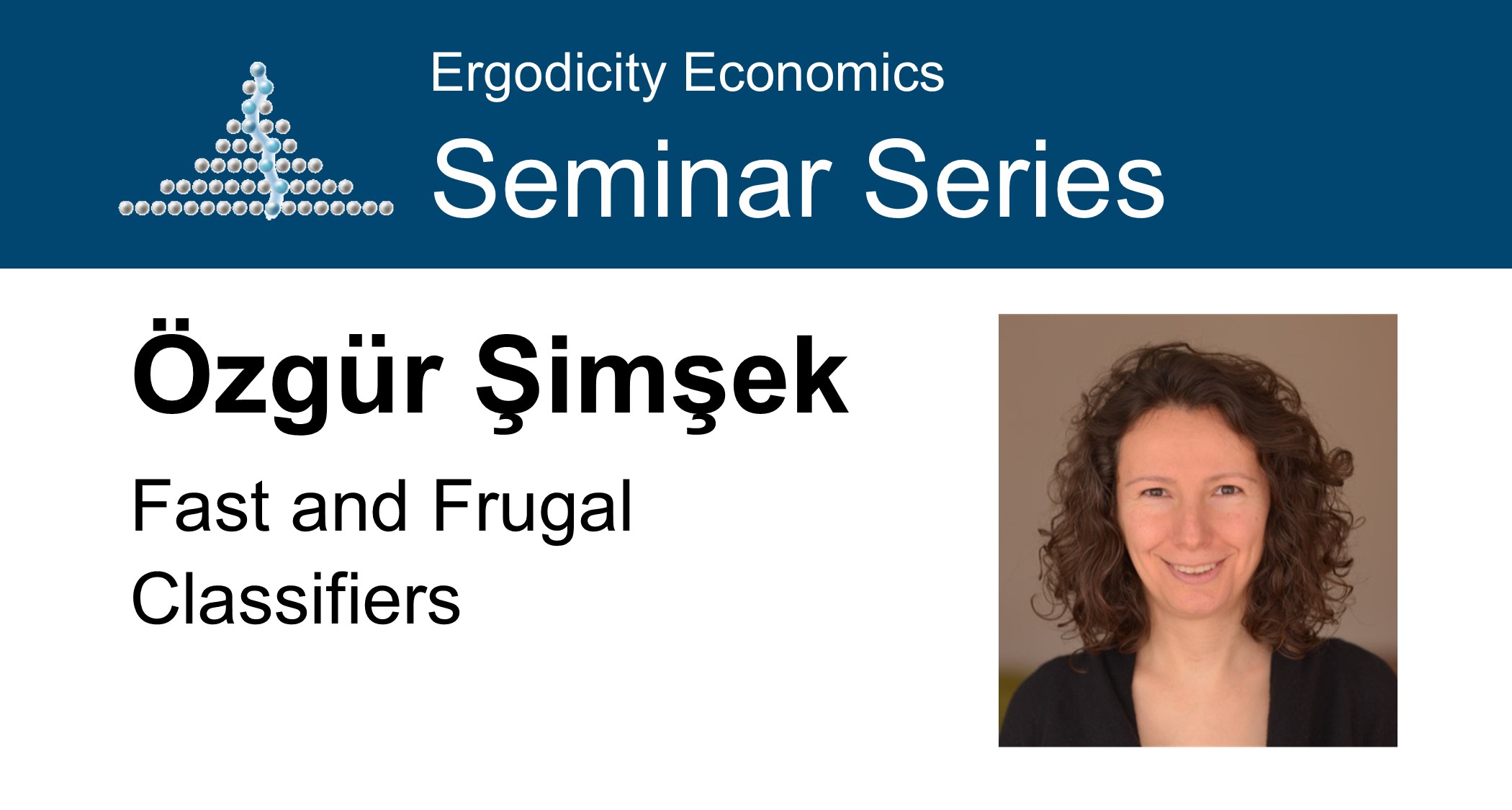
In this seminar, Özgür Şimşek (University of Bath) gives an introduction to fast-and-frugal classifiers. These are precise, formal models of classification designed to make fast, accurate, and transparent decisions in real-world situations. Two families of classifiers – tallying models and fast-and-frugal trees – are explored, and Özgür shows how to construct them using the R package ffcr: Fast and Frugal Classification in R. This R package accompanies the book Classification in the Wild: The Science and Art of Transparent Decision Making (Katsikopoulos, Şimşek, Buckmann, Gigerenzer; 2020), which describes fast-and-frugal classifiers, their applications, and the algorithms used to construct them in detail.
the seminar is very interesting. So I was wondering: what if one wants to take a loo at the book’ I cannot find it on Amazon and I do not understand, looking at the linked MIT press website, if it is possible to purchase it or not.
Hi Mirko,
I highly recommend the book! I bought my copy from Amazon UK: https://amzn.eu/d/ap3S3GX
It is also available from Amazon US (in case that suits your location better): https://a.co/d/f5VBXnd
After watching this presentation, I purchased Classification in the Wild and read every word. Excellent resource! In the presentation, at the end of the Q&A (before extra slide discussion) you mention there is a rich set of literature on ecological rationality. Where can I learn more? I need help to enhance the “art” side of cue selection!
Glad to hear that you found the presentation and the book useful! Some resources below, and you can find many others by following the links from these.
A relatively recent overview paper:
Gerd Gigerenzer, From bounded rationality to ecological rationality. In G. Gigerenzer, S. Mousavi, & R. Viale (Eds.)(2024), Elgar Companion to Herbert Simon (pp. 148–175).
The classic book:
Gigerenzer, G., Todd, P. M., & ABC Research Group, T. (2000). Simple heuristics that make us smart. Oxford University Press.
A more recent heuristics “reader”:
Gigerenzer, G. E., Hertwig, R. E., & Pachur, T. E. (2011). Heuristics: The foundations of adaptive behavior. Oxford university press.
Some papers on heuristics and ecological rationality:
Katsikopoulos, K. V. (2011). Psychological heuristics for making inferences: Definition, performance, and the emerging theory and practice. Decision analysis, 8(1), 10-29.
Şimşek, Ö. (2013). Linear decision rule as aspiration for simple decision heuristics. Advances in neural information processing systems, 26.
Şimşek, Ö., & Buckmann, M. (2015). Learning from small samples: An analysis of simple decision heuristics. Advances in neural information processing systems, 28.
Şimşek, Ö., Algorta, S., & Kothiyal, A. (2016). Why most decisions are easy in tetris—and perhaps in other sequential decision problems, as well. In International Conference on Machine Learning (pp. 1757-1765). PMLR.
Lichtenberg, J. M., & Şimşek, Ö. (2019). Regularization in directable environments with application to Tetris. In International Conference on Machine Learning (pp. 3953-3962). PMLR.
Katsikopoulos, K. V., Şimşek, Ö., Buckmann, M., & Gigerenzer, G. (2022). Transparent modeling of influenza incidence: Big data or a single data point from psychological theory?. International Journal of Forecasting, 38(2), 613-619.

Hi,
the seminar is very interesting. So I was wondering: what if one wants to take a loo at the book’ I cannot find it on Amazon and I do not understand, looking at the linked MIT press website, if it is possible to purchase it or not.
Thank you in advance.
Mirko
Hi Mirko,
I highly recommend the book! I bought my copy from Amazon UK: https://amzn.eu/d/ap3S3GX
It is also available from Amazon US (in case that suits your location better): https://a.co/d/f5VBXnd
Kind regards,
Emilie
Hello Emilie,
it must have been a glitch in Amazon.it’s operations yesterday. Today the book was available again on Kindle.
Really thanks a lot for taking the time to look into ti.
Kind Regards,
Mirko
After watching this presentation, I purchased Classification in the Wild and read every word. Excellent resource! In the presentation, at the end of the Q&A (before extra slide discussion) you mention there is a rich set of literature on ecological rationality. Where can I learn more? I need help to enhance the “art” side of cue selection!
Hello Todd,
Glad to hear that you found the presentation and the book useful! Some resources below, and you can find many others by following the links from these.
A relatively recent overview paper:
Gerd Gigerenzer, From bounded rationality to ecological rationality. In G. Gigerenzer, S. Mousavi, & R. Viale (Eds.)(2024), Elgar Companion to Herbert Simon (pp. 148–175).
The classic book:
Gigerenzer, G., Todd, P. M., & ABC Research Group, T. (2000). Simple heuristics that make us smart. Oxford University Press.
A more recent heuristics “reader”:
Gigerenzer, G. E., Hertwig, R. E., & Pachur, T. E. (2011). Heuristics: The foundations of adaptive behavior. Oxford university press.
Some papers on heuristics and ecological rationality:
Katsikopoulos, K. V. (2011). Psychological heuristics for making inferences: Definition, performance, and the emerging theory and practice. Decision analysis, 8(1), 10-29.
Şimşek, Ö. (2013). Linear decision rule as aspiration for simple decision heuristics. Advances in neural information processing systems, 26.
Şimşek, Ö., & Buckmann, M. (2015). Learning from small samples: An analysis of simple decision heuristics. Advances in neural information processing systems, 28.
Şimşek, Ö., Algorta, S., & Kothiyal, A. (2016). Why most decisions are easy in tetris—and perhaps in other sequential decision problems, as well. In International Conference on Machine Learning (pp. 1757-1765). PMLR.
Lichtenberg, J. M., & Şimşek, Ö. (2019). Regularization in directable environments with application to Tetris. In International Conference on Machine Learning (pp. 3953-3962). PMLR.
Katsikopoulos, K. V., Şimşek, Ö., Buckmann, M., & Gigerenzer, G. (2022). Transparent modeling of influenza incidence: Big data or a single data point from psychological theory?. International Journal of Forecasting, 38(2), 613-619.